

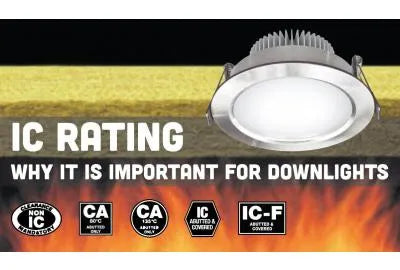
IC-Rated LED Downlights — What It Means & Why It Matters
When choosing recessed LED downlights, one specification that often causes confusion is the IC rating. This guide breaks down what IC rating is, why it’s important, and how it affects the safety and installation of LED downlights in insulated ceilings.
What Does “IC” Stand For?
“IC” means Insulation Contact — a rating that indicates whether a recessed downlight can be safely installed in direct contact with ceiling insulation.
In most modern Australian homes, insulation is installed in ceilings to reduce heat gain in summer and heat loss in winter. When lighting is installed, especially recessed downlights that sit inside the ceiling cavity, it’s critical that heat is managed safely.
Why IC Rating Matters
LED downlights generate heat during use. If this heat becomes trapped by insulation around the fitting, it can:
- create a fire hazard
- reduce the lifespan of the light
- cause ceiling discolouration or damage
IC rating standards were developed so downlights can be safely installed in insulated ceilings while minimising these risks.
What Are IC-Rated Downlights?
An IC-rated downlight is designed to be:
- directly in contact with insulation, and
- covered completely by insulation without any clearance gaps.
This means installers can lay insulation continuously across the ceiling without cutting around each light, making installation simpler and more efficient.
Benefits of IC-Rated Downlights
- Faster, easier installation
- Lower electrician labour costs
- Reduced fire risk
-
No compromised insulation — better thermal performance

What About Downlights Without an IC Rating?
Downlights without an IC rating (often labelled CA80 or CA135 depending on standards) cannot be covered by insulation.
If a non-IC downlight is installed in an insulated ceiling, the installer must:
- remove insulation around and above the fitting, and
- provide air gaps to allow heat to escape safely.
If this isn’t done correctly, the trapped heat can:
- become a fire hazard
- shorten the life of the downlight
- cause ceiling discolouration or heat damage

When Can Non-IC Downlights Be Used?
If there is no insulation in the ceiling space where the downlight is installed, a non-IC downlight can be used safely — because the heat can dissipate into the open cavity above.
However, with insulation now a standard feature in modern builds, this scenario is becoming less common.
Summary: IC vs Non-IC Downlights
| Feature | IC-Rated Downlights | Non-IC Downlights |
|---|---|---|
| Can be covered directly with insulation | ✔️ Yes | ❌ No |
| Insulation remains unbroken | ✔️ Yes | ❌ No |
| Installation complexity | Easy | More complex |
| Fire safety risk | Lower | Higher if installed incorrectly |
| Thermal performance | Better | Worse if insulation is removed |
Final Takeaway
Choosing IC-rated LED downlights is generally the safest and most practical option for modern homes with ceiling insulation. They allow for a simpler installation, maintain insulation effectiveness, and minimise fire risk — helping you enjoy efficient, long-lasting recessed lighting.


