

Ceiling Fan Blades: 3, 4, or 5 — Which Is Actually Best?

Shoppers comparing ceiling fans almost always land on the same question: does the number of blades actually change how well a fan performs? You'll find confident, conflicting answers across the web — some sites say more blades move more air, others say fewer blades are more efficient. Both are half-right, and neither tells the full story.
Blade count on its own has a small effect on performance. Motor type, blade pitch (the angle of the blade) and blade span (the length from tip to tip) do far more to determine airflow, noise and efficiency than whether a fan has 3, 4 or 5 blades. Choose your fan on style first, then check the motor type and blade span for the room it's going in.
The rest of this guide explains why the advice online is so inconsistent, what actually drives performance, and how to choose with confidence.
Why the advice online contradicts itself
Search for this question and you'll see three different answers from three credible-looking sources:
- "More blades move more air" — this comes from comparing two fans of the same span and motor, where an extra blade adds a small amount of additional surface pushing air.
- "Fewer blades are more efficient and move air faster" — this comes from the physics of drag: every extra blade adds weight and wind resistance for the motor to overcome, so a 3-blade fan of the same motor and span can spin faster for the same power draw.
- "More blades are quieter" — this is about distribution, not volume: spreading the same airflow task across more blades means each blade works slightly less hard, which can reduce vibration and blade-slap noise.
All three are true in isolation. None of them accounts for the fact that motor type, blade span and blade pitch vary between the fans being compared — which is why blade count alone is a poor predictor of real-world performance. Two 4-blade fans from different brands can perform completely differently depending on their motor and blade design; a well-engineered 3-blade DC fan will often out-perform a poorly designed 5-blade AC one.
Blade count at a glance

3-Blade Fans
Often more energy efficient with fewer parts, they tend to spin faster and can move strong airflow — a good fit for larger rooms, open-plan living areas, and outdoor spaces.
Shop 3-blade fans
4-Blade Fans
Balanced all-rounders, generally quieter than 3-blade fans of comparable design. A safe, versatile choice for bedrooms and living rooms.
Shop 4-blade fans
5-Blade Fans
Slightly quieter and smoother thanks to the extra blade distributing airflow, but that adds a bit more load on the motor. The difference from a 4-blade fan is mostly aesthetic rather than a meaningful airflow gain.
Shop 5-blade fans| 3-Blade | 4-Blade | 5-Blade | |
|---|---|---|---|
| Typical strength | Fewer parts, less drag on the motor, tends to spin faster | Balanced middle ground on noise and airflow | Smoothest, most evenly distributed airflow |
| Typical trade-off | Can be marginally louder at full speed | No strong trade-off — the "safe" middle choice | More load on the motor; heavier overall |
| Best suited to | Large or open-plan rooms, outdoor/alfresco spaces | Bedrooms, living rooms, most standard rooms | Bedrooms and studies where quiet matters most |
| Where it matters most | Efficiency and airflow in bigger spaces | All-round performance and looks | Noise-sensitive rooms and classic/hotel-style aesthetics |
This table is a starting guide, not a rule — always check the motor type and blade span of the specific fan before deciding based on the table alone.
What actually determines performance
If blade count isn't the deciding factor, these are:
Airflow (m³/h)
This measures how much air the fan actually moves, in cubic metres per hour — the single most useful number for comparing two fans directly. A fan with a high m³/h rating at low power draw is doing its job efficiently, regardless of blade count.
Power consumption (watts)
Pair the m³/h airflow rating with wattage. A fan moving similar air for less power is the better long-term choice, especially if it's running for hours each day through summer.
Blade pitch and blade span
Blade pitch (the steepness of the angle) and blade span (tip-to-tip length) affect airflow more directly than blade count. A fan with a steeper pitch and longer span will generally move more air than one with a shallow pitch and short span, independent of how many blades it has.

Motor type: DC vs AC
Motor type affects performance more than blade count does:
- DC Motors: Quieter, more energy efficient, and typically offer more speed settings — often 6 or more, versus the standard 3 on most AC fans.
- AC Motors: More affordable upfront, reliable, and widely available.
For a full breakdown, see our AC vs DC ceiling fans guide.
Blade material matters too
Plastic (ABS)
Most modern "plastic" fan blades are actually ABS (Acrylonitrile Butadiene Styrene) — a lightweight, engineered plastic that's moulded into precise, aerodynamic shapes. It's quiet, resists rust and moisture, and is a strong choice for bathrooms, coastal homes, and covered outdoor areas. See our full ABS ceiling fan guide for more detail.

Timber / Wood
Stylish and quiet, but less effective at moving air efficiently in very hot climates and needs more care over time.
Metal
Highly durable and well suited to high-use commercial or trade settings, though it can be noisier and is more prone to corrosion in coastal or humid environments.

Choosing by room
Once you've ruled out blade count as the deciding factor, match the fan to the room:
Bedrooms & studies
Prioritise a DC motor and a 4 or 5-blade fan for the quietest possible operation, especially if the fan will run overnight.
Living & open-plan areas
A 3 or 4-blade fan with a longer blade span suits larger floor areas better than blade count alone would suggest.
Outdoor & alfresco spaces
Look for ABS or metal-rated outdoor fans rather than choosing on blade count — material and IP/weather rating matter far more here.
Style fit
Once performance needs are covered, choose the blade count and finish that suits the room's look — modern minimalism generally pairs with 3-blade designs, while classic or hotel-style interiors often lean toward 4 or 5-blade fans.
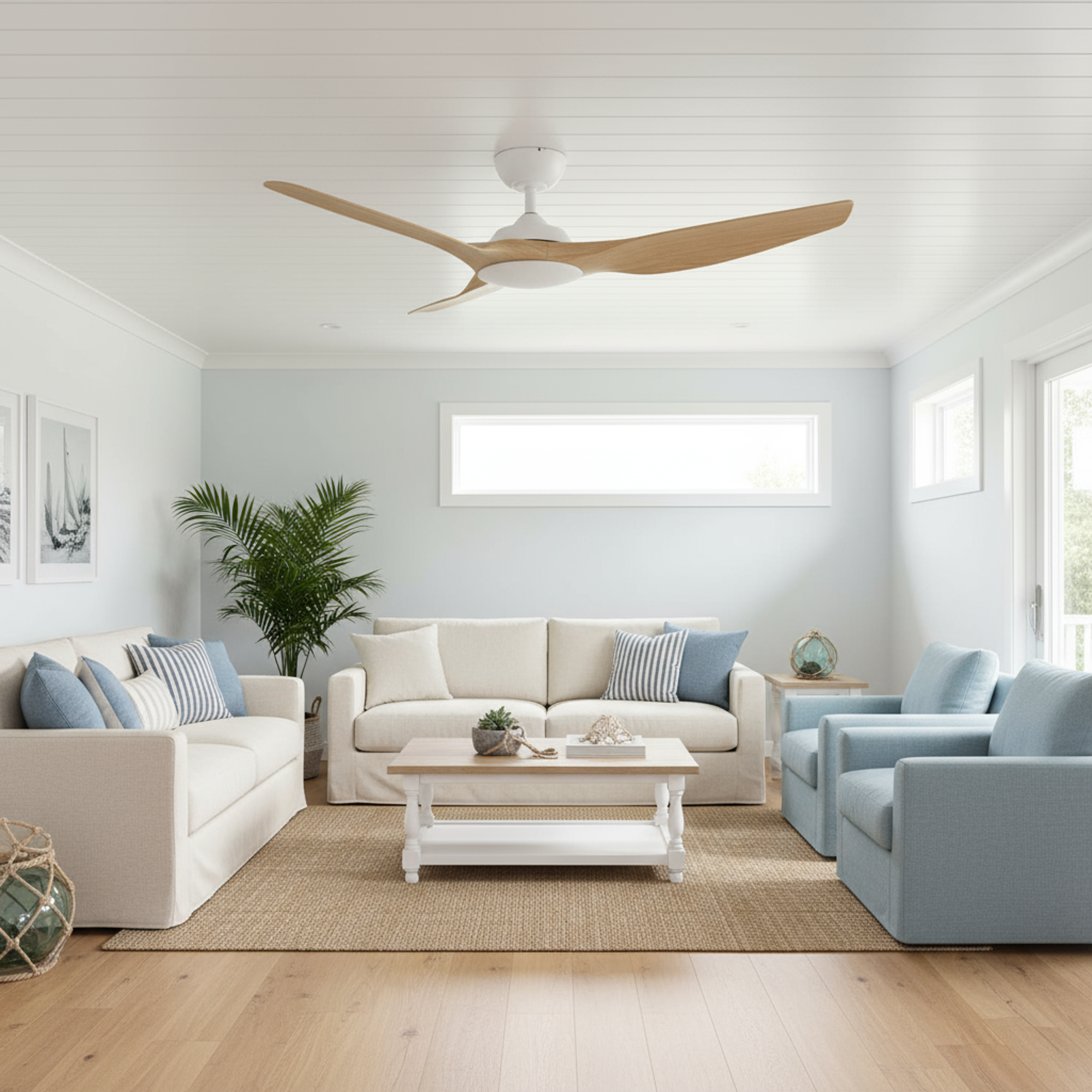
A quiet DC fan with ABS blades, like this one, suits bedrooms and living spaces where noise and low maintenance both matter.

Frequently Asked Questions
Is a 3, 4, or 5-blade ceiling fan better?
None of the three is universally "better." Blade count has only a small effect on real-world performance — motor type, blade pitch and blade span matter far more. A well-built 3-blade fan can easily out-perform a poorly designed 5-blade one. Choose based on the room and your noise/style priorities, then compare the m³/h airflow rating and wattage between specific models.
Is it better to have 3 or 4 blades on a ceiling fan?
4-blade fans are typically a touch quieter than 3-blade fans of similar design, since the same airflow is distributed across an extra blade. 3-blade fans tend to spin faster with less motor drag, which can suit larger rooms. For most standard bedrooms and living rooms, 4-blade fans are the safer, more balanced pick — but the gap is small enough that style and motor type should carry more weight in the decision.
Does a 5-blade fan move more air than a 3-blade fan?
Not automatically. Adding blades increases drag on the motor, which can mean a 5-blade fan needs to work harder to match the airflow of a well-designed 3-blade fan of the same span. Any extra blade tends to improve smoothness and noise distribution rather than airflow volume.
Why do most ceiling fans have an odd number of blades (3 or 5)?
It's mostly aesthetic and manufacturing convention rather than a performance rule. Odd-numbered blade arrangements are considered to look smoother and more balanced while spinning, and 3 or 5 blades keep the parts count (and cost) down compared to denser designs. Even-numbered fans (4 or 6 blades) perform just as well and are just as common.
Should I choose a 3 or 4-blade fan for a bedroom?
For bedrooms, prioritise the motor over the blade count — a DC motor fan will run quieter than an AC one regardless of whether it has 3, 4 or 5 blades. If you're choosing between otherwise similar 3 and 4-blade DC fans, the 4-blade option is usually the marginally quieter choice for overnight use.
What are ABS ceiling fan blades, and are they worth choosing?
ABS (Acrylonitrile Butadiene Styrene) is the lightweight engineered plastic used in most modern "plastic" ceiling fan blades. It's quiet, resists rust and moisture better than metal, and holds an aerodynamic shape well — making it a strong all-round choice, especially in bathrooms, coastal homes, and covered outdoor spaces. Read our dedicated ABS ceiling fans guide for the full comparison against timber and metal blades.
What should I actually compare if not blade count?
Airflow in m³/h, wattage (power draw), motor type (DC vs AC), and blade span and pitch. These four factors tell you far more about how a fan will perform in your room than counting blades in a product photo.
The bottom line
The number of blades on your ceiling fan won't make or break its performance for most homes. Focus on:
- Airflow (m³/h) and power draw (watts)
- Motor type — DC for quiet, efficient running; AC for upfront affordability
- Blade material suited to the room (ABS for bathrooms/outdoor/coastal, timber or metal for style-led spaces)
- The look that fits your room
Then pick the blade count and finish you actually like — performance-wise, you won't be giving anything up either way.


