

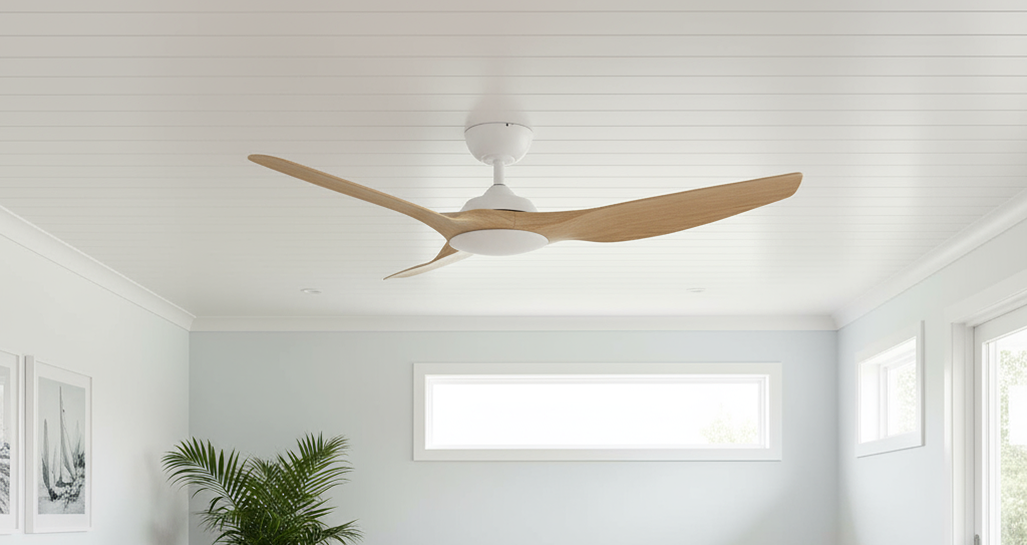
With temperatures soaring above 38 degrees Celcius, the last thing Aussies want is to return home to spend the rest of the day suffocating in a hot, stuffy and stifling home. So, whether you're lounging on the sofa reading a novel, enjoying a relaxing family dinner, or simply laying down on the bed, make sure you're under the right ceiling fan to keep the heat at bay.
Given the extremities of Aussie weather these days, you need not worry about the practicality of ceiling fans as there will be plenty of opportunities to use them all-year round. Many modern ceiling fans are now equipped with reverse cycle technology to allow for winter usage - by pulling hot air down and maximising the effectiveness of heaters.
Which ceiling fan should you buy, you ask? Ceiling Fans now come in all manners of shape, size, and colour, so picking the right fan can be a daunting task at first. To make your life easier, we've done some of the homework for you. We've come up with the following list of the Top 8 most important things to consider when choosing a ceiling fan.
The 8 Important Tips for Choosing a Ceiling Fan
1. The Size of Your Ceiling Is Vital
The first important thing to consider is the size of the room. This directly determines the appropriate overall fan size diameter. As a general rule of thumb, the larger the room is, the larger the fan size required to generate sufficient air movement and ventilation.
To choose the right fan size, measure the area of the room and compare it with the guidelines below. For example, a standard 5x5m (or 25m2) bedroom would require a blade size starting from 52" to achieve the optimal level of ventilation. Keep in mind that larger or irregular sized rooms may require multiple fans or specialised designs.
| Room Dimension (m2) | Fan Size (Inches) |
| Up to 7 - 13m² (3m x 3m small bedroom) | 42" - 48" |
| Up to 13 - 20m² (4m x 4m medium bedroom) | 48" - 52" |
| Up to 20 - 27m² (5m x 5m large bedroom, medium living area) | 52" - 60" |
| Up to 27 - 36m² (6.5m x 6.5m rumpus, large living area) | 56" - 64" |
| More than 36m² (Very large living area) | 60" & larger |
2. Consider the Usage Area - Indoor, Outdoor or Coastal Use
Ceiling Fans are rated for indoor, outdoor, or coastal usage. Some indoor Ceiling Fans are okay to use in sheltered outdoor areas, provided there is proper care and maintenance. However, an indoor Ceiling Fan should never be used in coastal areas as the surface area is not properly sealed against harsh coastal elements.
When choosing a fan for outdoor or coastal areas, it's important to look at IP ratings and corrosion-resistant materials. An IP (ingress protection) rating tells you how well a fan is sealed against dust and moisture. If your fan might get wet outdoors, aim for an IP44 rating. For areas that are exposed to the wind, rain, or salt air, look for fans made from durable materials such as ABS plastic or 316 Stainless Steel, which won't rust or corrode over time. Coastal-rated fans are specifically designed to withstand salty air and humidity, making them ideal for seaside environments or even high-humidity indoor areas like bathrooms or laundries.
The Zeus ceiling fan is a great choice for larger spaces and outdoor usage! Coming in varying blade sizes to suit a wide range of areas, you can find the perfect fit.

3. Don't Worry About The Number of Blades
With the current innovation in fan design, you're unlikely to notice major differences in the performance between fans with fewer or more blades. What counts more is the overall size of the fan and the speed of the fan (revolutions per minute). The key figure to look at is the volume of air moved by the fan, measured in m³h; the greater the number, the greater the air-flow.
4. How Fan Blade Material Affects Fan Noise
The material of your ceiling fan blades can affect not just how it looks, but also how it performs and how long it lasts, especially in different environments. Common blade materials include timber (or plywood), ABS plastic, and metal (stainless steel or aluminium). Each type of material has its respective pros and cons.
-
Timber or plywood blades offer a more natural, traditional aesthetic and are generally lightweight and quiet. They're a great choice for indoor areas and bedrooms where a softer, quieter airflow is preferred.
-
ABS plastic blades are a popular modern option. They are moulded into precise aerodynamic shapes, making them very efficient and often quieter than you might expect. ABS is also highly durable, corrosion-resistant, and ideal for outdoor or coastal conditions when combined with the right motor housing.
- Metal blades (usually stainless steel or aluminium) are sleek and robust, making them suitable for industrial or modern spaces. However, they can be a bit noisier than timber or plastic, especially if the motor isn't high-quality or the fan isn't well-balanced.
Keep in mind that noise levels are influenced by more than just blade material - the motor quality, fan design, and installation all play a big part. When choosing a fan, focus on matching the blade material to your space's style and conditions (e.g. indoor vs outdoor), rather than assuming one type is always better.
5. Extension Rods
Getting the installation height right is the key to both safety and airflow performance. In Australia, the minimum legal clearance for ceiling fan blades is 2.1 metres from the finished floor level, in accordance with the Australian electrical safety standards. This is to ensure safe operation and avoid any accidental contact with the blades, especially in rooms where people may be standing or walking underneath.
For standard ceiling heights (typically around 2.4 to 2.7 metres), most fans can be installed directly into the ceiling using the standard mounting bracket - this keeps the blades just above the 2.1m requirement while still providing effective airflow. However, for higher ceilings (3m or more), a downrod or extension rod is usually recommended to bring the fan closer to the "optimal airflow zone" - generally between 2.4 and 2.7 metres from the floor. Installing a fan too high up can reduce its cooling effectiveness, as the airflow may not reach the lower part of the room where you feel it most.
For sloped or raked ceilings, you'll need to check whether the fan is compatible with angled mounting, and you may require a special ceiling canopy or a longer downrod. Most quality fans list their maximum pitch allowance in their specs to allow customers to be more informed.
It’s also worth considering clearance from the ceiling itself. Ideally, the blades should sit at least 300 mm below the ceiling surface to allow for proper air circulation. Flush-mount or “hugger” fans are available for low ceilings where space is limited, but they often trade off some airflow efficiency due to tighter clearance.
No matter your ceiling type, always have your fan installed by a licensed electrician, as proper mounting is essential not only for compliance but also for avoiding wobble, vibration, or long-term wear.
6. Not All Ceiling Fan Motors Are Created Equal
Like the engine of a car, the motor determines the fan's ventilation effectiveness and its energy efficiency. There are currently two types of ceiling fan motor technology on the market - AC (alternating current) or DC (direct current). Typically, DC fans consume less energy than AC fans but can be slightly more costly to purchase. For example, a DC ceiling fan would consume 35W at full speed, whereas its AC counterpart may consume double that at 70W of energy.
The best ceiling fans deliver maximum airflow while consuming minimal power, making them both effective and energy-efficient.
A great AC Ceiling Fan is the FanForce Stratus, which comes in both 48" and 52" blade sizes, as well as being light kit adaptable.
For DC Ceiling Fans, the FanForce Revo is a great pick, which comes in multiple blade sizes and blade colours to suit any aesthetic in any room.
7. Light Kits and Remote Controls
Many ceiling fans are dual purpose and can either come fitted with a light or have the option to add in a light kit. This can be very useful if you want the simplicity of a light and a fan in one. It is also a good space-saving solution for smaller rooms. In addition, a remote control is also a great accessory that offers extra convenience to your life.
8. Appearance Matters
Lastly, while there are no strict rules for selecting the appearance of a ceiling fan, aesthetics play an increasingly important role. Ceiling fans are no longer purely functional appliances - they are now designed to enhance and complement both interior and exterior décor. Whether you're aiming for a coastal-inspired ambiance or a sleek modern look, there are fan designs available to seamlessly integrate with your chosen style.
Modern/Contemporary: One of the biggest trends in decorating homes is moving away from the old, big ceiling fans to newer, smaller, and more energy-efficient models. This change isn't just about ceiling fans; it also includes modern light fixtures, appliances, and furniture that are replacing their older versions. When you use these modern ceiling fans, it can impact the way your home looks on the inside. They are usually smaller than older fans and have curved blades, making them more visually appealing. In Australia, these modern ceiling fans have a simple and understated look that blends well with the overall decor. Modern/contemporary fans will typically have three or four blades and match the style of contemporary interiors.
Industrial: The Industrial style often features ceiling fans with three blades, which are characterised by their sharp and mechanical appearance. However, this industrial aesthetic is now making its way into larger ceiling fans with 6 to 8 blades and bigger diameters. This industrial look has gained popularity not only in commercial spaces like cafes, restaurants, and workplaces but also in larger residential settings.
Tropical: The Tropical style captures the essence of resort destinations and a laid-back way of life. It conjures the feeling of being on a vacation right in your home, with palm-shaped blades gently turning to create a soothing breeze. To achieve this tropical ambiance, modern ceiling fans utilise innovative all-weather polymer blades designed to mimic the appearance and feel of tropical leaves. These blades not only enhance the style but also offer durability and efficiency in air circulation, ensuring you stay cool and comfortable in any climate.
Things To Keep In Mind
Regulation Requirement
The Australian & New Zealand Standard requires that a fan should be installed so that the blades are more than 2.1metres from the floor. A fan should always be installed by a Licensed Electrician.
Enclosed Outdoor Installation
If the fan is to be installed in a covered outdoor area, the fan should placed at least 1.5 metres from the edge of the roof or eaves of the enclosure. This will keep the fan away from direct rain, water, and sunlight, as well as indirect water splashing which may cause damage to or expedite deterioration of the fan motor and exteriors.
Cost
Ceiling fans come in a range of prices, typically falling between $150 and $500. The cost depends on the specific model and its included features. A basic fan with a simple design and no extra features, like smart home capabilities or a remote control, tends to be more budget-friendly. In contrast, an ultra-modern ceiling fan crafted from high-quality materials and equipped with the latest technology will generally be on the higher end of the price spectrum. View our extensive ceiling fan range and find one that suits your budget today.
Frequently Asked Questions
What are the consequences of using a ceiling fan that is too large or too small?
When choosing a ceiling fan for a room, it is important to consider the size of the room and the size of the ceiling fan. An oversized ceiling fan can appear out of proportion and visually overwhelm the space. It may also generate a breeze that is too strong, making the room uncomfortable. On the other hand, a fan that is too small will struggle to circulate air effectively, resulting in poor airflow and inadequate cooling or ventilation.
How do I know which size ceiling fan to choose?
To choose the right size ceiling fan, it's important to match the fan's blade span to the dimensions of the room. Generally, larger rooms require fans with a larger blade diameter to move air efficiently. You can refer to ceiling fan sizing guidelines to help determine the appropriate blade size based on your room’s square footage.
Does the blade pitch affect fan performance?
Yes, the angle of a ceiling fan's blades, also known as the blade pitch, significantly impacts how effectively it circulates air. Blade pitch is measured in degrees and indicates the tilt of the blades relative to the fan's base. For smaller ceiling fans, a blade pitch of around 12 degrees is usually optimal. For standard-sized fans, a pitch between 13 and 15 degrees tends to provide efficient airflow for most room sizes.
Does the number of blades on a ceiling fan impact its noise level?
Yes, the number of blades can influence how quietly a ceiling fan operates. This is especially important in bedrooms or other quiet areas. Fans with four or five blades are often considered quieter because they provide better balance, reducing wobble and noise compared to fans with fewer blades.


